Misogyny, Sexism and Harassment
While there can be no doubt that there has been significant progress made in the journey towards gender equality within our society, much ground remains to be covered.
“Misogyny is a thriving form of communication. Adverts, song lyrics and belittling comments from influential public figures all play their part in promoting the increasingly casual use of misogynistic language across society. Whether used knowingly or as a means of identifying with the ‘in crowd’, the attitude it promotes among the perpetrators and the impact it has on the targets can be both long lasting and serious”. Mary Matheson Equality Committee Vice-Convener.
What is Misogyny?
Misogyny is a form of hate that targets women and girls and is more recently seen online. It’s promoted in different online communities, where influencers promote a narrative that women should be treated as less than men.
What is Sexism?
Sexism is prejudice or discrimination based on one’s sex or gender. Sexism can affect anyone, but it primarily affects women and girls. It has been linked to gender roles and stereotypes and may include the belief that one sex or gender is intrinsically superior to another.
What is Harassment?
Illegal behaviour towards a person that causes mental or emotional suffering, which includes repeated unwanted contacts without a reasonable purpose, insults, threats, touching, or offensive language. Some misogynists can appear to be pro-women when in fact they are the exact opposite.
How does this impact our children?
Children and young people, are at an influential stage of development and may:
• Form primitive beliefs based upon the views of famous online influencers who hold such
views.
• Pick up and display negative attitudes and harmful behaviours.
• Escalate negative attitudes towards females within their own social circles.
• Demonstrate gender bullying and harmful sexualised behaviours towards women and/or
girls.
How are these displayed?
Displays of misogyny among children and young people occur in a variety of forms and are
demonstrated, verbally, non-verbally, physically and through social messaging. It could be witness it in schools, social spaces and within the home. More increasingly, misogyny online has become a national concern.
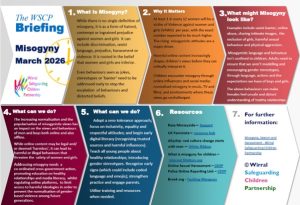
Access a 7 minute briefing, click on the picture below:
Legislation
The 2010 Equality Act identifies gender as a protected characteristic. Protected characteristics are identified on the basis that those who share them are proven to be vulnerable to disadvantage within society. Schools and colleges are bound by the terms of the Public Sector Equality Duty, part of the 2010 Equality Act, to: (a) Eliminate discrimination, harassment, victimisation and any other conduct that is prohibited by or under the Equality Act 2010; (b) Advance equality of opportunity between persons who share a relevant protected characteristic and persons who do not share it; (c) Foster good relations between persons who share a relevant protected characteristic and persons who do not share it.
Additional Training & Resources:
- RASA Merseyside – RASA Merseyside | Here For Anyone Who Has Been Sexually Abused or Raped
- Be Lads – help women feel safer
- What is misogyny for children – Internet Matters.org
- Tacking online hate & trolling – Internet Matters.org
- Online Sexual Harassment – CEOP
- Police Online Reporting Link – CEOP
- ‘Adolescence’ series – Netflix 2025
For Educational Settings:
- (Education version) Tackling Misogyny Toolkit
- Review of sexual abuse in schools and colleges – GOV.UK
- Everyone’s Invited
Also, see links to the Incel and Extreme Misogyny pages here – Involuntary Celibates (Incel) & Extreme Misogyny Ideology – Wirral Safeguarding Children Partnership